

Different Types of Wire Mesh: Structures, Materials, and Applications

Different Types of Wire Mesh
Wire mesh is one of the most versatile materials used in industrial, architectural, agricultural, and commercial applications. It is formed by interlacing, welding, or otherwise joining metal wires into a grid or network structure. The performance of wire mesh depends on its structure, material, mesh count, wire diameter, and open area. In this article, we will explore the different types of wire mesh, focusing only on meshes made of wire, with technical details and applications.
Different Types of Wire Mesh by Structure
Different types of wire mesh by structure include woven mesh, welded mesh, crimped mesh, knitted mesh, hexagonal mesh, wire rope mesh, and chain link mesh. Each structure offers unique strength, flexibility, and open area, making them suitable for applications like filtration, fencing, reinforcement, and architectural design.
Woven Wire Mesh
Woven wire mesh is produced by weaving wires over and under each other, similar to textile weaving. It is available in several weave patterns, each offering specific characteristics.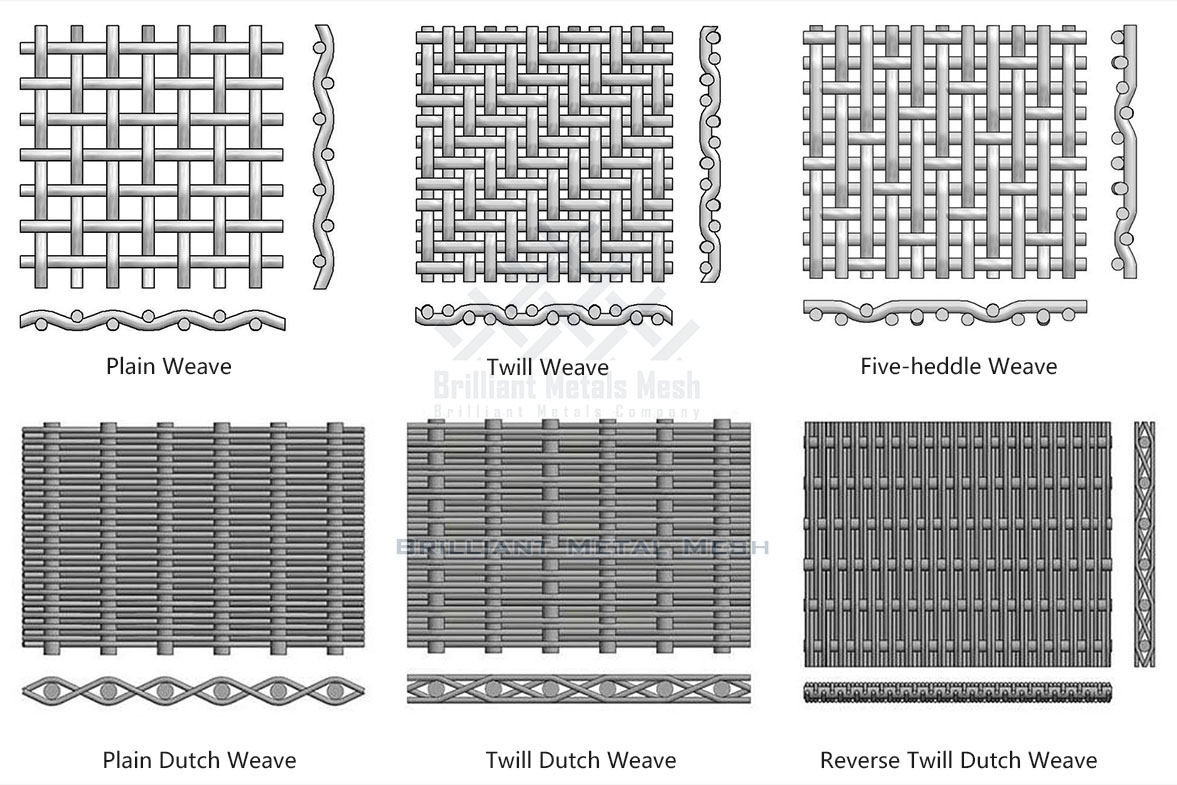
- Plain Weave: The most common type. Wires are alternately woven over and under.
- Mesh Count: 4 to 635 mesh (number of openings per inch).
- Wire Diameter: 0.02-3 mm.
- Open Area: 30-80%, depending on wire thickness and mesh count.
- Applications: Filtration, sieving, particle separation, insect screening.
- Twill Weave: Each wire passes alternately over two and under two. Allows for thicker wire at the same mesh count compared to plain weave.
- Mesh Count: 20-400 mesh.
- Wire Diameter: 0.025-2 mm.
- Open Area: 20-70%.
- Applications: High-pressure filtration, chemical and aerospace industries.
- Dutch Weave (Plain or Twill Dutch): Warp wires are thicker, and weft wires are packed tightly, creating a strong mesh with very fine filtration capability.
- Mesh Count: Up to 325 × 2,300 mesh (warp × weft).
- Wire Diameter: Warp 0.2-0.6 mm, Weft 0.02-0.06 mm.
- Open Area: 0-30% (sometimes nearly zero, forming a dense filter cloth).
- Applications: Fine filtration of liquids and gases, hydraulic systems, oil filtration.
- Reverse Dutch Weave: In contrast to standard Dutch weave, the weft wires are thicker and more widely spaced, while the warp wires are thinner and more numerous. This results in a stronger mesh with a wedge-shaped passage.
- Mesh Count: Commonly 80 × 700 to 300 × 1,200 mesh.
- Wire Diameter: Weft 0.1-0.5 mm, Warp 0.025-0.1 mm.
- Open Area: Typically low (5-20%), but with higher flow rates compared to standard Dutch weave due to wedge-shaped openings.
- Applications: Pressure and vacuum filtration, extrusion processes, polymer and plastic industries, fuel and oil filtration.
Welded Wire Mesh
Welded wire mesh is made by electrically welding intersecting wires at their junctions, producing a rigid and stable grid.
- Specifications:
- Mesh Size: 6 mm × 6 mm up to 200 mm × 200 mm.
- Wire Diameter: 0.5-6 mm.
- Open Area: Varies, generally 50-95%.
- Materials: Stainless steel, galvanized steel, low-carbon steel.
- Applications: Reinforcement in construction (concrete slabs, walls), animal cages, fencing, machine guards, partitions.
Crimped Wire Mesh
Crimped wire mesh is woven using pre-crimped wires to improve stability and uniformity. The crimps lock the wires in place, preventing movement.
- Types of Crimping: Double crimp, lock crimp, flat-top crimp, inter-crimp.
- Specifications:
- Mesh Count: 1-10 mesh (coarse openings).
- Wire Diameter: 0.5-12 mm.
- Open Area: 30-85%.
- Applications: Mining screens, quarry sieving, architectural facades, grill guards.
Knitted Wire Mesh
Knitted wire mesh is made by interlocking loops of wire, similar to fabric knitting. It is highly flexible and resilient.
- Specifications:
- Wire Diameter: 0.1-0.5 mm.
- Density: Varies by compression (can be compressed into pads or cylinders).
- Materials: Stainless steel, copper, Monel, galvanized steel.
- Applications: Demisters, mist eliminators, sound attenuation, EMI shielding, sealing gaskets.
Hexagonal Wire Mesh (Chicken Wire)
Hexagonal wire mesh is woven into a hexagonal pattern, commonly used for lightweight applications.
- Specifications:
- Mesh Size: 10 mm to 100 mm (flat-to-flat).
- Wire Diameter: 0.3-2 mm.
- Open Area: 70-90%.
- Materials: Galvanized steel, stainless steel, PVC-coated wire.
- Applications: Poultry netting, fencing, insulation backing, rockfall protection (gabions).
Wire Rope Mesh
Wire rope mesh is constructed from intertwined wire cables, usually stainless steel, connected with ferrules or knots.
- Specifications:
- Rope Diameter: 1-4 mm.
- Mesh Size: 20 mm × 20 mm up to 300 mm × 300 mm.
- Open Area: 60-95%.
- Applications: Zoo enclosures, safety nets, green wall systems, balustrades, architectural decoration.
Chain Link Mesh
Chain link mesh (or chain link fence) is made by spirally interweaving wires into a diamond pattern.
- Specifications:
- Mesh Size: 25 mm × 25 mm to 100 mm × 100 mm.
- Wire Diameter: 1.2-5 mm.
- Open Area: 60-80%.
- Materials: Galvanized steel, PVC-coated steel, stainless steel.
- Applications: Perimeter fencing, sports fields, security barriers.
Specialized Wire Mesh Types
- Architectural Wire Mesh: Decorative woven or crimped patterns with controlled open areas, used for facades, ceilings, partitions, and sunshades.
- Sintered Wire Mesh: Multiple woven layers sintered together for precise filtration, strength, and backwash capability.
- Hardware Cloth: Light welded or woven mesh (e.g., 1/8-1/2 inch openings), commonly used in gardening, pest control, and home projects.
Types by Materials
The types of wire mesh are usually categorized by structure, but material plays an equally important role in determining performance. Factors such as corrosion resistance, tensile strength, conductivity, and cost depend directly on the wire material.
Stainless Steel Wire Mesh
Stainless steel wire mesh is the most widely used type due to its combination of strength, corrosion resistance, and durability.
- Common Grades: 304, 304L, 316, 316L, 310, 321.
- Specifications:
- Mesh Count: 1-635 mesh.
- Wire Diameter: 0.02-6 mm.
- Open Area: 10-85% depending on weave and thickness.
- Properties: Excellent resistance to rust, acids, alkalis, and heat. High tensile strength and long service life.
- Applications: Industrial filtration, sieving, petrochemical processing, food processing, architectural facades, security screens.
Galvanized Steel Wire Mesh
Galvanized wire mesh is made from carbon steel wire with a zinc coating for corrosion resistance. It is more affordable than stainless steel but less durable in harsh environments.
- Types: Electro-galvanized and hot-dip galvanized.
- Specifications:
- Mesh Size: 6 mm × 6 mm up to 200 mm × 200 mm.
- Wire Diameter: 0.3-6 mm.
- Properties: Good corrosion resistance (shorter lifespan than stainless steel), cost-effective, easy to work with.
- Applications: Fencing, animal enclosures, partitions, concrete reinforcement, garden mesh.
Low Carbon Steel / Black Wire Mesh
- Low carbon steel mesh, often referred to as black wire mesh, is made of uncoated mild steel wire. It is strong but prone to rust if not treated.
- Specifications:
- Mesh Count: 1-100 mesh.
- Wire Diameter: 0.3-5 mm.
- Properties: High strength, low cost, weldable, but limited corrosion resistance.
- Applications: Concrete reinforcement, industrial sieving (dry materials), partitions, mining and quarry screens, temporary fencing.
Copper Wire Mesh
Copper wire mesh is valued for its high electrical and thermal conductivity, corrosion resistance, and malleability.
Specifications:
- Mesh Count: 2-400 mesh.
- Wire Diameter: 0.05-2 mm.
- Open Area: 40-80%.
Properties: Non-magnetic, antibacterial, excellent shielding against electromagnetic and radio frequency interference (EMI/RFI).
Applications: EMI shielding, insect screens, batteries, scientific research, arts and crafts, interior decoration.
Brass Wire Mesh
Brass wire mesh is an alloy of copper and zinc, combining strength with corrosion resistance. It is more durable than pure copper and has a golden appearance.
Specifications:
- Mesh Count: 2-250 mesh.
- Wire Diameter: 0.05-2 mm.
Properties: High abrasion resistance, good formability, attractive golden finish, moderate corrosion resistance.
Applications: Decorative mesh, fireplace screens, filtration of liquids and powders, sieving, cabinet door mesh.
Bronze Wire Mesh
Bronze wire mesh is an alloy of copper and tin, offering better strength and wear resistance than brass.
Specifications:
- Mesh Count: 2-250 mesh.
- Wire Diameter: 0.05-1.6 mm.
Properties: Resistant to seawater corrosion, non-sparking, durable.
Applications: Marine filtration, aerospace components, decorative applications, oil and gas filtration, electrical shielding.
Aluminum Wire Mesh
Aluminum wire mesh is lightweight, non-magnetic, and resistant to atmospheric corrosion. It is easier to cut and form than steel-based meshes.
Specifications:
- Mesh Count: 2-200 mesh.
- Wire Diameter: 0.1-2 mm.
Properties: Lightweight, resistant to oxidation, economical, non-toxic, excellent electrical conductivity.
Applications: Insect screens, window and door mesh, lightweight partitions, ventilation systems, EMI shielding.
Nickel Wire Mesh
Nickel wire mesh is used in specialized applications requiring resistance to high temperature and chemical attack.
Specifications:
- Mesh Count: 1-400 mesh.
- Wire Diameter: 0.05-3 mm.
Properties: Excellent resistance to acids, alkalis, and corrosion. Performs well in high-temperature environments.
Applications: Fuel cells, chemical processing, aerospace, battery industries, hydrogen production.
Monel Wire Mesh
Monel wire mesh is made from a nickel-copper alloy, highly resistant to seawater and harsh chemicals.
Specifications:
- Mesh Count: 2-200 mesh.
- Wire Diameter: 0.05-2 mm.
Properties: Exceptional resistance to seawater corrosion, acids, and alkalis. Stronger than pure nickel or copper.
Applications: Marine engineering, oil refining, desalination plants, filtration in corrosive environments.
Titanium Wire Mesh
Titanium wire mesh is lightweight, strong, and highly resistant to corrosion, especially in seawater and chemical environments.
Specifications:
- Mesh Count: 1-400 mesh.
- Wire Diameter: 0.1-3 mm.
Properties: High strength-to-weight ratio, biocompatible, non-magnetic, excellent seawater resistance.
Applications: Aerospace, marine filtration, medical implants, desalination, chemical processing.
Duplex Stainless Steel Wire Mesh
Duplex stainless steel wire mesh is manufactured from duplex alloys such as 2205 and 2507, which combine the properties of austenitic and ferritic stainless steels. This gives the mesh higher strength and improved resistance to stress corrosion cracking compared to standard stainless steels like 304 or 316.
Specifications:
- Mesh Count: 2-325 mesh.
- Wire Diameter: 0.025-3 mm.
- Open Area: 10-80% depending on weave type.
Properties:
- Roughly twice the yield strength of 300-series stainless steels.
- Superior resistance to pitting, crevice corrosion, and chloride stress corrosion cracking.
- Good weldability and toughness.
Applications: Offshore oil and gas platforms, seawater desalination, chemical processing, pulp and paper industries, and high-pressure filtration systems.
When selecting wire mesh, material is just as important as structure. Stainless steel wire mesh provides durability and corrosion resistance, galvanized steel offers cost-effective fencing, while copper, brass, and bronze add conductivity and decorative appeal. For extreme environments, nickel, Monel, and titanium wire meshes deliver superior performance.
Understanding the different types of wire mesh by materials helps engineers, architects, and buyers choose the right solution for filtration, reinforcement, shielding, or decorative use.